
How Many Neurofeedback Sessions Will I Need?
A practical answer for people planning a neurofeedback program.
The Short Answer
No one can predict how many sessions your brain will need. For one person it may be 40; for another, 80. The number matters less than this: the most common mistake is stopping before the new patterns have been practiced enough to hold.
Our own records guide how we plan. Among our clients who trained between 2019 and 2026, a third trained fewer than 40 hours and two-thirds trained 40 hours or more. Among those, the typical course was about 60. That’s why our program is built around 60 sessions, with more available if you need them. It isn’t a promise or a target for you; it’s what our data tells us. See how our program is built.
You’ll often see 20–40 sessions quoted for neurofeedback. That’s marketing, not data.
The Three Stages of Training
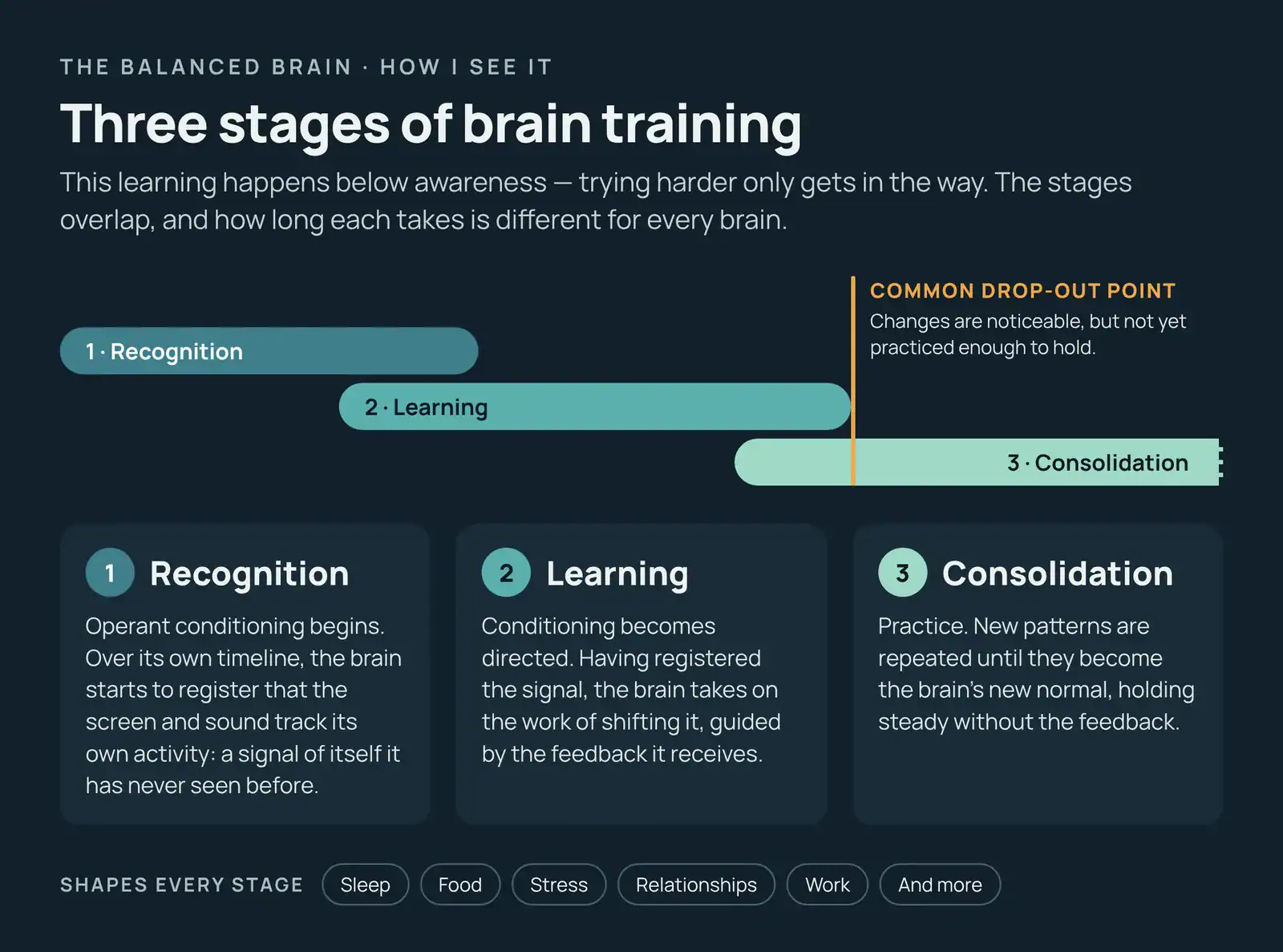
Neurofeedback is learning, and it happens below awareness. Trying harder doesn’t speed it up. Training moves through three overlapping stages, and how long each takes is different for every brain.
1. Recognition. In the first sessions, your brain starts to notice that the screen and sound are tracking its own activity: a signal of itself it has never seen before. Many people feel little at this stage, and that’s normal.
2. Learning. Having registered the signal, the brain takes on the work of shifting its own patterns, guided by the feedback it receives. This is often when people begin to notice changes, sometimes subtle ones that others see first.
3. Consolidation. Practice. New patterns are repeated until they become the brain’s new normal, holding steady without the feedback.
Where People Stop Too Soon
Partway through training, changes become noticeable, but they haven’t been practiced enough to hold. This is the most common point for people to stop, and it’s easy to understand why. You feel better. Training takes time and money. It’s natural to ask, “I feel great, so why am I still doing this?”
In our experience, this is where the trouble starts. Stopping here is one of the main reasons people later say neurofeedback “wore off” or that they needed tune-ups. It’s a lot like cramming for a test: you can pass the exam, and most of it is gone a week later.
Consolidation is what makes change last. New patterns are repeated until they become your brain’s new normal and hold steady without the feedback. From the outside, it can look like nothing is happening. But this is the stage where the brain fully takes on what it has learned.
Our goal is that you shouldn’t need to keep coming back for tune-ups. That’s different from what happens when life hits hard: a death, a divorce, a job loss or a serious illness can throw any brain off its stable patterns. In our experience, a small amount of retraining usually gets people back to feeling balanced and capable, because a brain that has learned a pattern before tends to find its way back to it faster.
What Affects How Many Sessions You'll Need
Your goals for training, your current stress and life demands, your sleep and overall health, and how regularly you train all shape how many sessions you’ll need. Sleep, nutrition and stress matter at every stage, which is why our program pairs neurofeedback with coaching. Schedule matters too: see how long training takes and why frequency matters.
How We Approach This at The Balanced Brain
Rather than counting toward a fixed number, we compare two things in every session: what your brainwave data shows, and how you describe your own state and performance. Progress is when those start to line up, so that what you feel matches what we see. That match, holding steady, is how we judge when training has done its work.
Noticing your own changes isn’t always easy, so it’s a regular part of coaching: helping you recognize what’s different and what still needs work.
Ready to see whether this approach makes sense for you?
Schedule a Discovery Call to talk through what’s been going on,
ask questions, and learn whether brain training may be a good fit.
Related Professional Resource
For broader professional context on neurofeedback, you can visit
the International Society for Neuroregulation & Research.