
How Often Should I Do Neurofeedback?
A practical answer for people planning their training schedule.
The Short Answer
For most of training, we recommend at least two sessions a week. We usually start at three, when your brain is learning the most, and step down as the changes show they’re holding.
Each session gives your brain a small lift that partly fades in the days that follow. When the next session comes before much of that fades, the gains build on each other. When sessions are a week apart early on, more of each one fades first, so progress is slower for the same effort.
Why Frequency Matters
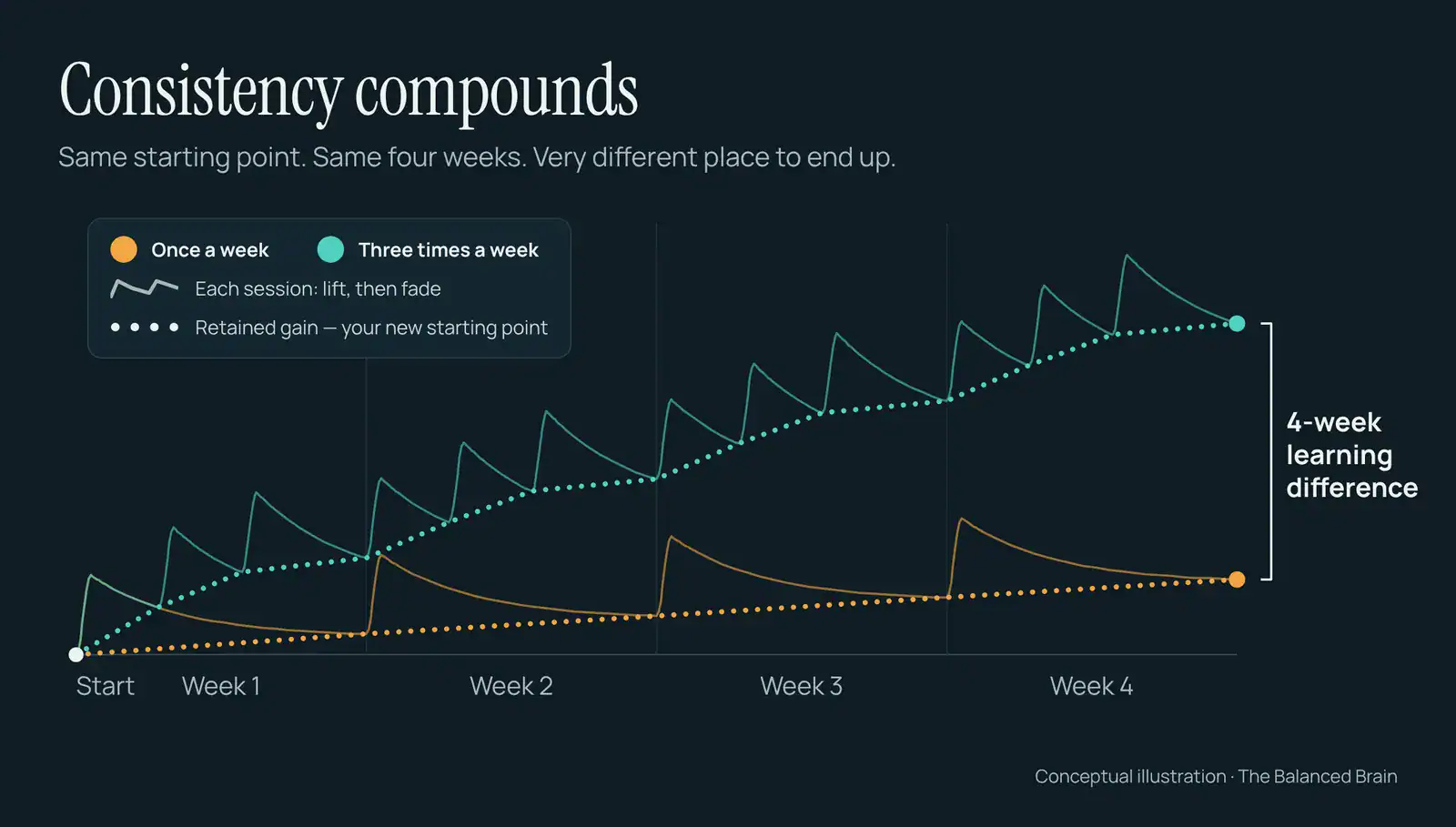
Think of each session as a lift followed by a gradual fade. What’s left when the fade levels off is your new starting point. Train again soon, and you begin the next session higher. Wait too long, and you begin close to where you started.
The illustration shows the idea: same starting point, same four weeks, very different place to end up. It’s a conceptual picture of the pattern we see in practice, not a measurement of any one person’s brain.
Like Training at the Gym
Think about getting stronger at the gym. Each workout builds on the one before. Go once a week, and you may hold your ground, but you rarely build much: too much of each workout’s gain is gone by the time you return. Go two or three times a week, and each session starts close to where the last one left off.
The gym also shows why rest matters. Muscles get stronger during the recovery between workouts, not only during them. The brain works the same way: it needs time between sessions to settle what it practiced. Learning research points in the same direction: practice that is spread out and repeated holds better than practice crammed together.
Is More Always Better?
Not necessarily. There’s no solid research yet on the ideal spacing for neurofeedback sessions, so we’re upfront that our schedule is a judgment call. We approach neurofeedback as training, not treatment, and learning of almost any kind holds better when practice is paced, with time between sessions for the brain to settle what it practiced.
That’s why we don’t recommend packing sessions together just to finish sooner. Two to three sessions a week, kept up over months, is the rhythm that has made the most sense in our practice.
What If I Miss a Week?
Life happens: travel, illness, a busy stretch at work. A missed week doesn’t erase your progress. What matters is the overall rhythm. When you can’t keep up your usual schedule, let us know and we’ll plan around it so the gaps stay short.
Your Schedule Changes Over Time
Training doesn’t stay at the same pace from start to finish. We start strong, usually three sessions a week, because that’s when your brain is learning the most and consistency matters most. As changes take hold, we step down to two sessions a week. Toward the end, sessions spread out further, to once a week and then every other week.
Each step down happens only when we’re satisfied the new patterns are holding: your session data stays steady, and so do the changes you report. Spacing sessions out is part of consolidation itself. It shows that your brain can keep its new patterns with less and less feedback.
So you won’t be coming in three times a week for months on end. The schedule thins out as your brain shows it no longer needs it.
How We Approach This at The Balanced Brain
Most clients train for at least four to six months, and some, especially those working through more complex challenges, train for a year or longer. We can’t know your path until we begin, because sleep, stress, nutrition and the nature of what you’re working on all shape it.
What we can give you is a clear process. We review your progress at every session, comparing what your brainwave data shows with how you’re actually feeling, and we adjust your schedule as the changes show they’re holding. For more on the overall length, see How Long Does Neurofeedback Take? For how many sessions our clients have actually trained, see How Many Neurofeedback Sessions Will I Need?
Ready to see whether this approach makes sense for you?
Schedule a Discovery Call to talk through what’s been going on,
ask questions, and learn whether brain training may be a good fit.
Related Professional Resource
For broader professional context on neurofeedback, you can visit
the International Society for Neuroregulation & Research.